Expectations vs reality: how to hold expectations without losing your happiness


Reading time: 4.45 minutes
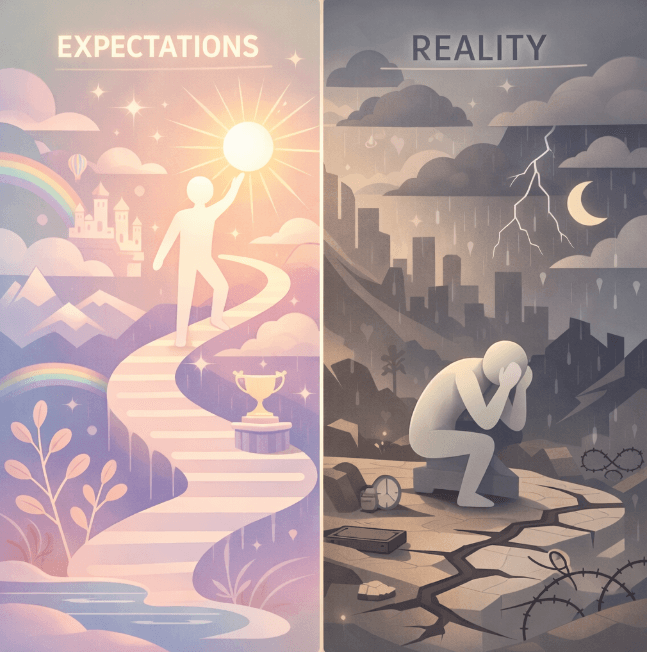
Happiness is often influenced by something we rarely stop to examine: the gap between what we hoped would happen and what actually happened.
Whether it's a relationship, a promotion, a business opportunity, or a personal goal, that gap can shape how satisfied, frustrated, or fulfilled we feel.
Over the past few weeks, I've been reflecting on a simple but powerful idea: happiness is often shaped by the distance between expectations and reality. The larger that distance becomes, the more likely we are to experience disappointment.
The question isn't whether expectations are good or bad. The more interesting question is how we can hold onto hope, ambition, and excitement while protecting our wellbeing when life doesn't unfold exactly as planned.
Why Expectations Matter More Than We Realise
You can think of expectations as an emotional investment.
When we imagine a future outcome, we don't just think about what might happen. We often picture how we'll feel when it happens. We mentally rehearse the conversation, the achievement, the relationship, or the opportunity long before it arrives.
The more emotionally attached we become to a specific outcome, the harder it can feel when reality takes a different path.
Here's the science:
Research suggests our brains are constantly making predictions about future events. When reality differs from those predictions, we experience what psychologists call a prediction error, which can trigger feelings of frustration, disappointment, or sadness.
This happens across every area of life:
- relationships
- friendships
- work and career progression
- business ventures
- personal goals
- and even our expectations of ourselves
Often, the disappointment isn't coming solely from the outcome itself. It's coming from the gap between what we expected and what actually happened.
Why We Can't Simply Eliminate Expectations
At first glance, lowering expectations might seem like the easiest solution.
After all, if you expect very little, there's less room to feel disappointed.
But expectations serve an important purpose.
They help us dream bigger than our current reality. They give us something to look forward to. They motivate us to take action and pursue meaningful goals.
Imagine planning the trip you've always wanted to take without any anticipation.
Imagine working towards a promotion while feeling completely indifferent about the outcome.
Imagine meeting someone new without any curiosity about where the connection might lead.
Life without expectations would feel flat and uninspiring.
Expectations bring colour, excitement, and possibility into our lives. The challenge comes when our emotional wellbeing becomes overly dependent on a particular outcome unfolding exactly as imagined.
When Expectations Become Too Heavy
Sometimes disappointment has less to do with reality and more to do with the weight of the expectations we're carrying.
Many ambitious women place enormous pressure on themselves, often without realising it.
Thoughts like:
- I should be further ahead by now.
- I should have everything figured out.
- I should be able to handle this perfectly.
- I shouldn't struggle with this.
can quietly shape how we experience our lives.
These expectations often sit beneath perfectionism, people-pleasing, and self-criticism. They create standards that are difficult, and sometimes impossible, to meet.
When reality inevitably falls short, disappointment follows.
If high self-expectations are something you struggle with, you might also enjoy our article on The Root Cause of Perfectionism and How to Overcome It.
How to Manage Expectations Without Losing Optimism
The goal isn't to become detached from life.
Nor is it to lower every expectation until disappointment disappears.
What tends to work better is developing a healthier relationship with expectations themselves.
Here are three practices that can help.
Hold Goals Strongly, Outcomes Lightly
There's a difference between being committed to a goal and becoming attached to one specific outcome.
You can care deeply about something while remaining open to different possibilities, timelines, or paths along the way.
This mindset allows you to stay motivated without feeling emotionally crushed when circumstances change.
2. Separate Hope From Certainty
Hope sounds like:
"I'd love this to happen."
Certainty sounds like:
"This has to happen."
One leaves room for possibility.
The other creates pressure.
The more we can recognise the difference, the easier it becomes to navigate setbacks without feeling defeated by them.
3. Build Flexibility Into Your Thinking
When reality doesn't match your expectations, try asking yourself:
- What else could be possible here?
- What can I learn from this experience?
- Is there another perspective I haven't considered?
This approach, often called cognitive reframing, helps us adapt more effectively when life takes an unexpected turn.
Inside the selfsquared app, we explore practical tools like cognitive reframing, journaling, and guided reflection to help you navigate disappointment while staying connected to your goals.
A Reflection Exercise
Take a moment to think about a recent situation that left you feeling disappointed.
Ask yourself:
- What expectation did I have?
- Was that expectation realistic?
- Did I communicate it clearly?
- How attached was I to a specific outcome?
- What might change if I loosened my grip on that expectation?
Now think of a situation where you entered with very few expectations and ended up pleasantly surprised.
Compare the two experiences.
- Which felt better beforehand?
- Which felt better in the moment?
- Which felt better afterwards?
Your answers may reveal more about your relationship with expectations than you realise.
Finding the Balance Between Hope and Reality
Like many aspects of wellbeing, the answer rarely sits at either extreme.
Holding impossibly high expectations can leave us vulnerable to frequent disappointment.
Having no expectations at all can strip life of excitement, anticipation, and meaning.
Hope, optimism, and ambition all have an important place in a fulfilling life.
The challenge is learning how to stay open to possibility without tying your happiness to a specific outcome.
Disappointment is part of being human. Every meaningful life includes moments where reality doesn't match the picture we had in our minds.
Resilience comes from trusting that when those moments happen, you can adapt, learn, and move forward without losing your sense of optimism.
If you're finding it difficult to break patterns around disappointment, perfectionism, or people-pleasing, our 1:1 coaching sessions provide personalised support to help you build emotional resilience and self-trust.
You can also join one of our group workshops, where we explore practical tools for confidence, wellbeing, and sustainable personal growth in a supportive environment.
////
Frequently Asked Questions:
- Why do expectations lead to disappointment?
Disappointment often occurs when reality falls short of what we hoped or expected. The larger the gap between expectations and reality, the stronger the emotional response can be. - Is it healthier to have low expectations?
Not necessarily. Expectations can create motivation, purpose, and excitement. What matters most is maintaining flexibility when outcomes differ from what you imagined. - How can I manage expectations better?
Focus on what you can control, separate hope from certainty, communicate expectations clearly, and practise reframing situations when things don't go according to plan.