Why AI might be burning you out (even when it's helping you)


Reading time: 4.25 minutes
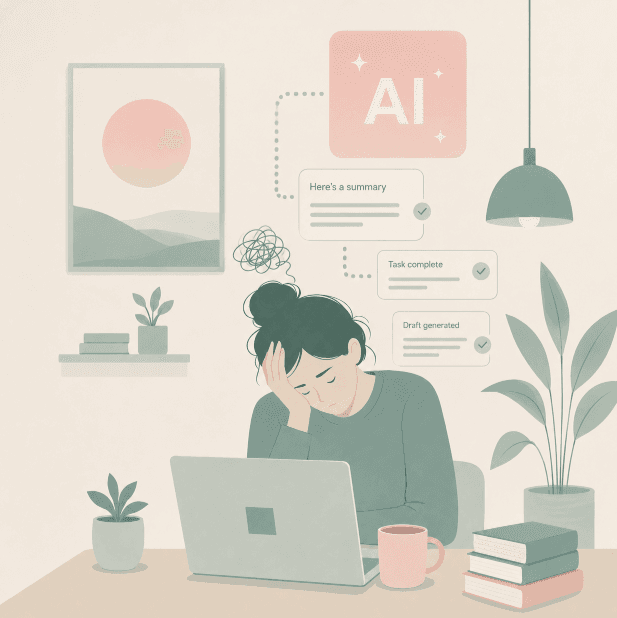
On the quiet cost of a tool that never gets tired — and neither, apparently, are you supposed to.
There is a version of the AI productivity story that sounds like freedom. Automate the boring stuff. Reclaim your time. Work smarter, not harder.
Then there is the version that nobody really talks about: you finish your work faster, look at the clock, and realise there are still four hours left in the day. So you do more. You take on another project. You say yes to something you would have previously said no to. You raise the bar on your own output because, well, you have AI now. What's your excuse?
That loop (quiet, gradual, totally self-inflicted) is becoming one of the defining wellbeing stories of our time.
The Numbers Nobody Is Celebrating
AI adoption has exploded. Between 2024 and late 2025, workplace AI use climbed from 55% to 78% of businesses. Nearly every C-suite leader surveyed expects AI to boost productivity. The pitch is compelling.
The reality is messier. A Quantum Workplace survey found that employees who frequently use AI report 45% higher burnout rates than peers who use it less. A 2024 study of radiologists found that those consistently using AI tools were 39% more likely to experience burnout — and the more they used it, the higher the odds climbed. Upwork's research found that 71% of full-time employees are already burned out, at exactly the moment that 81% of executives have increased their demands on those same employees, partly because AI is supposed to absorb the difference.
The tool designed to reduce pressure is, in many workplaces, being used to justify adding more of it.
The Treadmill That Got Faster
Here is the dynamic worth naming directly: AI does not reduce the amount of work available to you. It reduces the time it takes to do a unit of it. Those are not the same thing.
When a task that used to take two hours now takes twenty minutes, the healthy response would be to do that task and then genuinely rest, think, or disconnect. Instead, most people — especially high performers, especially people who care about their work — fill that gap. They take on more. They deliver faster. They set a new baseline for what is expected, including by themselves.
Coaches call this the achievement trap. The moment you hit a goal, the goal moves. AI has just made the goal move faster than most people can keep up with consciously.
The psychological term is "scope creep of self-expectation." You are not being asked to do more by anyone outside you. You are just noticing that you could, and letting that possibility become an obligation.
Why we do not ask
Here is where it gets interesting from a coaching perspective. Most people can identify what they need in retrospect. Ask someone why they felt deflated after a conversation and they can usually name it eventually: I needed them to ask how I was first. I needed them to not look at their phone. I needed to know they were actually listening.
But in the moment, before the interaction, most people do not voice the need. And the reasons are consistent.
It feels too small to say out loud. It feels needy, or high-maintenance, or like putting pressure on someone. There is a quiet belief, often unexamined, that a good person should not have to ask for this. That if someone really cared, they would just know.
That belief is doing a lot of damage in a lot of relationships, including the one people have with themselves.
The truth is that naming a microneed is not the same as being demanding. It is the opposite. It is being specific enough about what you need that the other person actually has a chance of meeting it.
What Staying Sane Actually Looks Like
The answer is not to use AI less. It is to use it with intention, and to guard your time and energy with the same seriousness you would give any other resource.
Here is what we have found to be particularly effective across our selfsquared community:
Define done before you start. Before opening a single tool, write down what finishing looks like today. Not "make progress on the project" — what specifically is complete at the end of this session? AI makes it easy to keep going indefinitely. You need a stopping point that exists before the energy runs out.
Protect time that is not for output. Thinking, reading, walking, talking to someone — these are not inefficiencies to be optimised away. They are where judgment, creativity, and perspective actually come from. If AI handles the execution, you need more of that upstream thinking, not less. Block it in your calendar like it matters, because it does.
Notice when "I could do more" becomes the plan. That thought — I could fit one more thing in — is the moment to pause, not accelerate. Ask yourself: is this coming from energy and genuine desire, or from discomfort with having capacity? Those are very different reasons to say yes.
Set a hard stop and mean it. One of the quieter costs of AI tools is that they make it easier to work at odd hours. A quick prompt here, a summary there. Before long, work has no edges. Pick a time and stop. Not "finish this one thing and stop." Stop.
Separate speed from value. Faster output is not automatically better output. One of the most useful questions to build into any AI-assisted workflow is: does this actually need to exist, and does it need to exist right now? Producing more at speed is only useful if the more is worth producing.
Check in with yourself weekly, not quarterly. Burnout does not arrive all at once. It accumulates in small decisions: skipped lunches, shortened evenings, weekends where you just do a few things. A weekly ten-minute honest check-in (how am I actually doing?) catches the drift before it becomes a crisis.
The Real Question
AI is a genuinely powerful tool. It can do in minutes what used to take days, and that matters. But a tool that never gets tired, never needs a break, and never feels overwhelmed will always be able to do more than you can. The question is whether you are going to keep trying to match it.
You are not a productivity machine. You are a person. Your energy is finite, your attention is precious, and your capacity to do good work depends on protecting both.
The most sustainable use of AI is not the one that extracts the most output from you. It is the one that frees up enough space for you to stay curious, present, and well.
That is a choice that AI cannot make for you. And it does not start with a better prompt. It starts with knowing when to close the laptop.
///
If this landed with you, it might be worth scheduling a complementary 1:1 call with us here to talk in more detail about effective strategies you can use in your day to day!